Monday, 1 October 2012

The Future of Interaction Design

I found this interesting website; 
http://worrydream.com/ABriefRantOnTheFutureOfInteractionDesign/


It is written by a man who was once involved in the design and testing of interfaces for the future. 

He used these 2 diagrams and states that good tools converts what we can do into what we want to do. 


The writer says that human needs and technology are two very throughly explored concepts. But what is lacking attention is human capabilities. The design visions of the future with glass interfaces thin as paper and applied to everything rely primarily and often singularly on tapping and swiping of fingers. 

Hands are capable of doing two main things;
1. Feel 
2. Manipulate

The pictures he used (below) are very effective ways in showing how natural human movement have been transferred to a glass interface. However, the purpose of these pictures for the writer, was to suggest that the sliding finger often used on touch screen devices, is a very unnatural thing for a human to do, and is rarely used in any real situation (these 2 images show the only situations he could think of). But I think the images he chose were quite compelling in convincing of it actually being a "natural movement". It appears to be an instinctive kind of action. Even though the particular movement is not necessarily encouraged or supposed to be done, it seems to be something that people can't help themselves from doing. In both situations, it is a natural and intuitive thing to do. 


The author does have a very interesting side of an argument, where he encourages readers to challenge the future of touch glass interfaces. As the future of this ignores human capabilities and the two things that hands are made to do. There are other possibilities into the future that involve more interactive and communicative forms and technology. 

he finishes his "rant" with; 


"The next time you make breakfast, pay attention to the exquisitely intricate choreography of opening cupboards and pouring the milk — notice how your limbs move in space, how effortlessly you use your weight and balance. The only reason your mind doesn't explode every morning from the sheer awesomeness of your balletic achievement is that everyone else in the world can do this as well.

With an entire body at your command, do you seriously think the Future Of Interaction should be a single finger?"

Tuesday, 25 September 2012

Future Technologies


http://matadornetwork.com/life/24-incredible-new-technologies-youll-see-by-2021/

The url above is a link to a webpage called 23 Incredible New Technologies you'll see by 2021.

There are some particular ones I found interesting.

The Paralysed will Walk
This prediction is based on using a "machine-brain interface". Enabling human thoughts to take control of their own mechanical limbs which is apparently being developed at present for use within military contexts. I think if this technology is ever successfully developed it will be used for a lot of different applications such as phones and computers possibly even cars. This a bit of a shame though, it takes away any interaction and connection with the interfaces and products. Yes, for the application of moving mechanical limbs would be great but for uses particularly the car I think a lot of meaning will be lost. Driving a car is all about interacting with he physical controls, steering wheels, peddles and even smaller things such as indicators and radio. All of these actions and movements create an experience and I think reaching the age to be able to do all of these things is quite a milestone, and if technology takes all of these things away I think that generation will be at a great loss. Even the current and very near future of automatic cars which sense obstacles and can park themselves, is taking away a very symbolic and meaningful experience. 

The Rise of Electronic Paper
This one is seen regularly in futuristic technological visions of the futures. So this concept is nothing new and not something we could hardly be shocked about. The future of it is to appear just like ink on paper (as does the kindle) but eventually reach a form of interactive full colour video. 

The average PC has the Power of the Human Brain


The main points I got from this diagram are
1.             Nano technology- The "necessity" of making everything as small as possible. has become a sign of quality and superiority. Good from an environmental perspective, saving material and reducing waste and enables different technologies to combine and added into the one product. 
2.             Augmented Reality
3.             Intelligence is the most interesting human phenomenon- So much research and money goes into developing intelligent technologies. Computers are able to do more and more things which will eventually lead to humans and machines becoming equal. 
There was an interesting discussion at the bottom of this web page where someone commented saying that its selfish for people to be imagine, want and be developing augmented realities which is something really not necessary or required, when there are people in poverty with no water and food. 
Another person replied and said there would be some way in which augmented realities would be able to make a positive impact on those people as well. 
The next person commented saying; "Leave the starving to the unexceptional and the followers. These creative people are truly serving mankind by doing what humans are meant to do- to create, to build, to Invent! The greatest disservice a man can perform is not to neglect his fellow man, but to neglect himself and his true potential!"

I think the last comment is quite a bold statement. There are some parts of which I don't agree with. I think that design and technology should be utilised and developed in a way which is not purely to make things already easy easier and become technology based just because it can be. They should be developed to solve problems and fix things that aren't right. It may seem like poverty and science, technology and design are very far apart and have no relation but really these are the things that can make the world better. 


Monday, 24 September 2012

Week 9 Presentation Feedback

We got to hear the thoughts of all the tutors which was really good! We did get some conflicting messages which is a bit confusing but it has given us lots to think about so it can only make our concept better.

First we spoke to Caroline. The feedback we got:

  • She wanted us to steer away from the "game" concept as it was hard to achieve without making it gimmicky and novelty based. I agree with this in the way that we would struggle to further design the game in a way which people would want to keep playing rather than just a few times then stop. 
  • The concept didn't clearly express the macro scenario in which it was based. 
  • We should explore more and put more focus onto our ideas of creating a communication form which doesn't require the blunt sharing of stories or information but rather the sharing of presence and non verbal companionship. 
  • We all know and understand our scenario we just need to make sure our design communicates this. 
From all of this we were thinking we will have to scratch our whole concept but we understood everything Caroline was saying so its best to do it sooner then later.


Next we went up to talk to Marienella, Yasu and the man from Life-Tec. Here we got lots of good ideas and a whole lot of things to think about. They didn't really say ditch the game idea but more how to achieve the same result in a less complicated way. We didn't get to talk to them for long as there was lots of groups left and the class was nearly finished. Marienella suggested we watch the movie The Spanish Apartment, so I will have a look at that one in the holiday week.

Notes taken from feedback. 

After this we had a brief chat with Leonardo. He was really keen on the game idea still and thought that getting rid of the game wasn't necessarily the best solution.

So I guess we will just have to rethink our concept a bit whether its game based or not and just make sure it supports our macro and micro scenarios.

Wednesday, 19 September 2012

Week 9 Presentation

Preparing for the summative presentations was difficult as week 9 was a very busy week for us all assessment wise. 

VIDEO
Below is the groups video. 
From the video making it became clear to us that there were still a lot of unresolved issues in the concept which we hadn't even considered. It has become quite a complicated game, which would most definitely require the reading of instructions or manuals to understand. This is certainly not what we had intended. 


However, from the rough prototype that is used in the film it seems to be a relatively simple device to create a working model for. Even thought the model making doesn't begin for a while, I think it is very important that we keep this in the back of our minds. Creating a model that works is a large part of the assessment so we must not forget that eventually, we will have to build it. 

DESIGN BRIEF
Working on the very first attempt at the design brief for the project, brought to mind some much finer points that we hadn't yet thought about. things like ensuring the product is compatible with systems around the world, how we can enable people with disabilities to use the product in the same way and what kind of materials would be ideal from a functionality point of view. Doing the brief really helped to solidify the overall concept of what we want to achieve and how the product will achieve this. 

Even if our concept changes between after the informal presentations i feel doing all of these things for the presentation has helped the hole team in more clearly understanding our goals and aims. 

PRESENTATION BOARDS
We struggled to put together full presentation boards so early on in this stage of the project. Because there were still so many gaps and things we didn't know yet we had difficulties in choosing relevant things to include. 


Tuesday, 11 September 2012

Week 8

This was our last class before the concept presentations next week. Even though the presentation isn't actually assessed as a part of our grade, I think it's very important that we get as much done for the presentation as we can, to as high of a standard as we can. that way we can receive relevant feedback that will actually impact our final assessment.


Today we started refining our concept and really working out what we wanted it to do as well as some of the finer details. We have decided to put together our two concepts (from concept bomb and lifetec excursion). 
The only tutor who was abel to see us was Leo. He was very helpful and put us onto the right track and  got us into thinking about all the things we needed to think about and focus on.
The pain points from Leo were:

- In game play there are always rules. They can be simple or complex but without rules the game does not exist. 
- There must be a progression. When someone plays for the first time, they are not very good and don't know much about the game. However through experience and time, the player can potentially become an expert. 
A bad game is one that is either too hard or too easy for the player at the start. The person may play two or three times, and then never again because it's too easy it's boring, or because it is too hard and they're not getting anywhere. 
- Learning curves are important. Particular incidents which teach the player lessons and impact their playing in the future. 
-Exploring the degree in how well it works. There may be times when the game just doesn't work, and other times when it works great. The middle ground is very worth exploring. 


Taking all of this into consideration we began brainstorming ideas for new games and what has been effective in existing games and how we could possibly integrate these features with technology. 
Main ideas:

- An interactive mat which is made up of numerous squares. The squares light up and move around. The player must hit all of the coloured squares to make them disappear. This concept is more team work based. rather than competing with friend, you work with them to achieve a common goal. The friend is doing the exact same thing on the other end. If the two players tap the same square at the same time, more coloured squares appear. If all if the colours are gone, the players win. They loose if the coloured squares take over and fill up the whole mat. 
I quite like this concept. It's simple but it would be a great way to interact with a friend in a fun and exciting way. It wouldn't be too hard to make up into a working model either. Although i'm not sure it would  necessarily utilise existing human behaviours. 


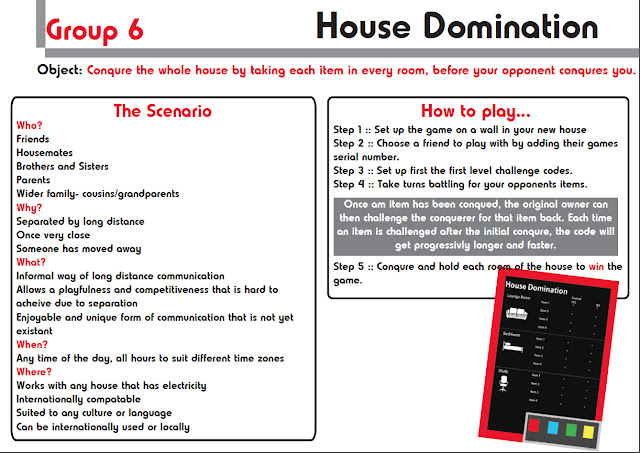
-Based on the board game "risk". This game is all about "conquering" your friends home. With a certain amount of rooms to use and a designated number of object within that room, players have to gradually take over the space. By having a smaller interactive game which earns a player points, territory is claimed. The small game involves one player entering a sequence of coloured squares into an interactive mat. The player on the other side will be shown the sequence once, and then they are to repeat it. As the game progresses, the sequences get longer and faster. When a colour is pressed on the mat a particular tone sounds. This makes the game more interactive but also includes people with low vision. 
This concept is much more complex and has much more smaller details to figure out. I think this one will be more of a challenge but could also be very rewarding. This one is also creating a fun way for people to interact. 


Board Games that require Interaction


Tuesday, 4 September 2012

Week 7

Excursion


Today was our second trip as a group to visit Life-Tec at New Market. It was refreshing to get out of the classroom for some more hands on investigative research. It was extremely beneficial to be able to hear from people there who know all about usability and user experience.  The trip was a great way to see some practical and innovative applications of electronic devices.  Although the centre is very focused on certain user groups and demographics that aren't necessarily relevant to our project, the principles and approaches are very much transferrable to us. I always find this centre very interesting to explore. It is amazing having a whole industry based on designing for disabilities, the elderly and different capabilities. There are some very clever products in the centre. Not specifically in regards to the project but more from a usability point of view, some of the products that stood out for me were; 


The cutlery with thicker handles and a bent in end to make eating much easier.
The simple adaptation of a key board to suit the visually impaired, high contrast keys for high visibility and larger letters. 
Suction container. A very clear idea which allows people with arthritis to use containers without difficulty. 


It was quite interesting to hear how the LifeTec staff spoke about the designing of the products in a usability and experience way but from backgrounds of occupational therapists. I found it was very similar to the ways in which we are taught as Industrial Designers. It's good that there are no significant differences or contradictions between the two. Health and design appear to work very closely and well with each other.


Activity:
In our groups for our project we were to;
Select a product from the store
Analyse it's design and attempt to redesign or alter the product to; 
Make it easier or more effective for it's targeted users
OR
Make useable for groups/purposes other than for those with disabilties or speical needs
OR
Relate back to class project 

Our group decided we may as well use the activity to relate it back to the project we are currently doing. As we are still in the concept stage, this task could help us expand or solidify our concept. 

What we came out with at the end of the activity was actually quite interesting.

The objects we selected were two ordinary looking balls. Inside the balls were some kind of bells or chimes. When the balls were moved, the inside components made noise. These balls are to assist visually impaired in playing sports. 


These products are quite simple and appear to have not much potential for improvements, as they serve their primary purpose. So from looking at the products from the perspective of our project, we saw plenty of opportunity. 

Our concept from the activity:

Working on the same theme as the concept we had come up with last week of: Communicating with friends/family on other sides of the world.

From this we also thought to consider people with disabilities, who are sick at home and aren't able to go out or travel. 
This concept involves connecting people through play. In particularly competition. When living away from people who you were once close with, a sense of competitiveness is something that is very difficult to achieve because of the distance. 

Using a ball (selected product) as the main working part of an arcade style game. the game enables two people living away from each other to compete. 

The first person picks up the ball, which is connected wirelessly to its partner. By giving the ball a shake, the accelerometer inside indicates the movement to the other person by making a noise (encased vibrator inside ball). This signals to the second person, that their friend is challenging them and wants to play!
A hand outline on the ball with pressure points in the fingers will recognise when both player are in position ready to begin the game. The two players challenge each other and shoot the ball into the hoop/hole as fast as they can. The game displays a count of how many points each player has scored. Red lights will indicate the player is loosing and green will turn on when they are winning. 


I feel like the activity we did today was very beneficial to our group. It prompted our thinking further and we now have another concept to think about. We are not sure whether will we change to the one we came up with today or the one we agreed on after the concept bombs. Perhaps we will end up merging them into one big super concept?


Tuesday, 28 August 2012

Week 6

It was nice to have a bit of a rest from this subject for a week and have time to focus on other subjects. Today in the class we started work on our next project. To start thinking about possibilities and opportunities with the topic of news we did 3 concept bombs as a class. I feel this was a good way to get us thinking and engaged with the project. We had all been doing research tot help with the project, but I know a lot of us hadn't really started thinking about concepts to explore throughout the rest of the semester. 


It was kind of nice to do concept bombs again like in first year. I know we did some last semester as well  I think they are a very useful exercise. The requirement for quick thinking and ideas in response to a brief, I think builds skills that we wouldn't have had otherwise. 

CONCEPT BOMB 1.

The first concept bomb I found surprisingly un-stressful. I got an idea straight away and was able to work with. I had a bit of a panic during the twenty minutes though, when Yasu was talking. He was telling the class about these devices they attached to bicycles. Which is what my concept was based upon. Thankfully the purposes of the two ideas were quite different. Phewwfff! In the one Yasu was talking about, the cyclists rode around and the device would measure air pollution and quality of the area. My concept was a handlebar attachment which included a motion sensor. The sensor would gather information about traffic. As the cyclists were riding around, the sensor would pick up any movement from cars driving past. However if there was heavy traffic in the morning and the cars were at a standstill, nothing would trigger the sensor, indicating the heavy traffic. The data could then be sent elsewhere. 


CONCEPT BOMB 2. 

This one was a storyboard format and was more focused on a scenario or experience rather than an actual physical product. We were asked to think about how we could keep in touch with someone who wasn't in the same space, but in a way as if they were. The concept I explored was considering the relationship of  a young child and a parent, but when a parent is far away and not able to be there with the baby. My particular scenario was a father who had to go for a business trip and leave his family for a while. The father gives the child a bangle. He also has an armband which he wears to stay connected to his child. The babies bangle is fixed with an accelerometer. The device monitors the child's movements and delivers them to the father. Different degrees of vibration signify babies movement ie. playing, emotion and activeness. When the fathers band is still, this means the baby is sleeping, calm or quiet. This device allows the father to still feel a bond with the baby from a long distance.

CONCEPT BOMB 3. 

This brief was definitely the most difficult out of the three. This one was quite particular. It makes it quite tricky not being able to rely on screens, but i guess this does make you think more outside the box. My concept was, a large picture of a world map to be displayed on the wall. There are tiny bulbs all over the map. These bulbs light up a particular colour based on what category of news they are displaying. For example if all the bulbs are blue, they are making indications about the weather, if they are purple, they are showing particular design notices around the world. A hand clap by the user will switch news topics. The bulb's light vary in intensity. The brighter the bulb, the bigger the story, if it is only a dull/dim glow, then the story in this place is quite small. A very bright light that is flashing signifies a breaking world story. A press of the particular light bulb enables an email to be sent straight to the user with details of the story.


Going around and marking off selected concepts for each of our class mates was a great way to see a whole range of all creative, innovative and feasible concepts. I found a lot of the students' third concept bombs were the most interesting and valuable concepts. Which is interesting, as I think this is the one most people struggeld with the most. It took a lot of people a while to think of a concept to work with. But i think this shows the rewards of exploring a difficult topic and thinkining more deeply into he possibilities. I also think that a lot of the students individual markings were based a little bit on the presentation. I found this personally, that the most poorly presented concept got the least number of ticks. This is just something to keep in mind when looking at final concept selection.


SELECTING A FINAL CONCEPT FOR THE GROUP

As a group we decided to go with one of Georgina's concepts which was quite interesting and try to combine the ideas with my third concept (above). 


 As a group we discussed some of the elements and main points that we wanted to utilise for our final project. 

  • Communicating friends/family etc all around the world
  • Creating an intimate experience for people separated by a long distance
  • Using the  individuality of handwriting to create a personal and special way of communication 
  • The ability to see hands and the touching of a surface from another country
  • Using sensors and lights to indicate the closeness of a person
  • Mapping to keep track of friends 
I think the class has been quite successful and the group has made a good productive start to the project.